
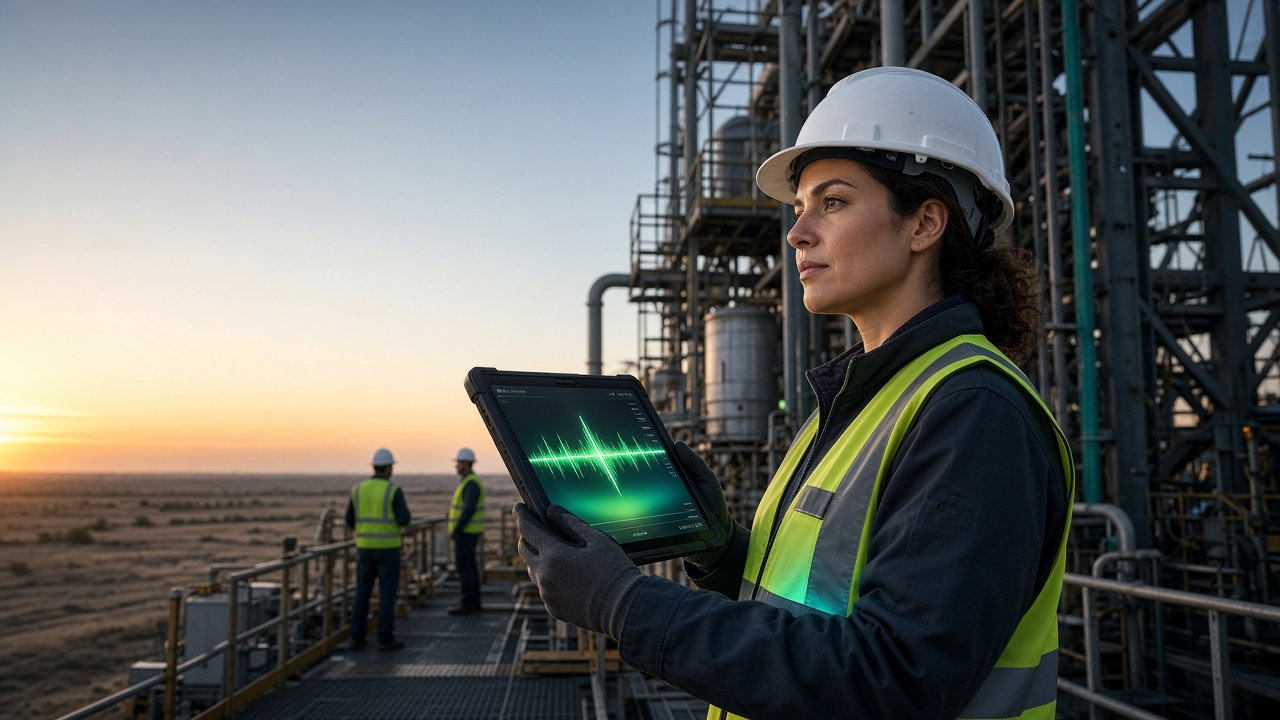
Picture a founder standing on a drilling rig at 5 a.m. Her sensor is doing exactly what she promised it would: catching a vibration pattern that signals a failure days before it happens. The crew is impressed. The site manager asks for a copy of the data.
She has four months of cash left, and no idea who at this company can actually buy what she’s built.
We’ve watched some version of that scene play out more times than we can count. The technology works. The customer wants it. And the company still doesn’t make it.
Innovators call it the valley of death. In heavy industry, it’s deeper than anywhere else due to regulatory issues, HSE concerns, and the risks inherent in scaling new technology. And right now it’s costing us more than ever.
Industry has never needed this technology more
Electricity demand is climbing fast. Data centers, chip fabs, and reshored manufacturing are reshaping regional economies almost overnight. Digital tools are finally reaching industries that operated on analog systems for generations. And roughly three in four energy and utility employers say they can’t find the skilled workers they need.
Put those together and you get operators who desperately need technology that automates, predicts, and does more with fewer people. Corporates want innovation. Startups have it. Investors want to back it. The thing that’s broken is the path in between.
Why it’s so hard to get in the door
In software, you can ship on Monday and have users by Friday. Industrial technology has to earn its way in, and it has to clear three hurdles to do it.
First, it has to survive the real world: the heat, the vibration, the dust, and twenty-year-old equipment nobody wants to touch. Then it has to be safe and reliable at scale, because one failure on a live operation can cost millions. And finally, it has to fit the way the customer actually buys, with procurement, security reviews, integration, and a business case that holds up when finance gets involved.
Most startups clear the first hurdle, and usually only in controlled conditions. Industrial buyers need all three.
Here’s how that tends to go. A company builds an AI tool that reads equipment manuals and maintenance logs and tells technicians exactly what to fix. In testing, it’s brilliant. On site, it works on the first try. Then the customer asks how it connects to their maintenance system, who supports it at 2 a.m., and whether it has passed their cybersecurity review. The startup has good answers to none of those questions, and eighteen months later it’s still “in evaluation.” Nothing was wrong with the product. Everything around it just wasn’t ready.
The two things startups can’t get on their own
The first is a real world place to prove themselves. The infrastructure that matters, such as test wells, heavy equipment, power systems, and full-scale operations, took decades and enormous capital to build. Almost all of it sits behind corporate walls, and startups rarely get the keys.
The second is commercial know-how: how to navigate procurement, design a pilot that ends in a purchase order, and scale manufacturing and service. Even great technology dies without it.
Corporates feel this too. Their teams are stretched running the core business, and sifting through dozens of unproven startups is a distraction most can’t afford. And most operators are not particularly good at finding, evaluating and helping new tech solutions succeed. So promising ideas get lost in the noise.
Pilot-first beats pitch-first
We’ll say something that may be unpopular: most corporate innovation labs are where good technology goes to die. They’re built to explore, not to buy. They sit too far from the business units that own real problems and real budgets.
What works is execution. Match vetted technology to a specific operational problem. Put it in a real environment with clear success criteria. Get the people who sign purchase orders involved from day one. And stay in the room until there’s a contract.
We’ve seen what happens when that’s done right. In energy, structured six-month pilots paired with actual business units are already turning into commercial agreements with major operators and partnerships with global technology companies. Not in years. In months.
This isn’t just an energy problem
Data center operators, semiconductor fabs, grid operators, and automation companies all face the same gap and the same talent crunch. A predictive maintenance tool proven on a drilling rig can be repurposed to protect a data center’s cooling system. A technician trained in industrial automation can work in a power plant or a chip fab. The lines between these industries are blurring, and the innovators who move fastest will be the ones who build across them.
Back to that rig
The founder on that rig at 5 a.m. didn’t need a better product. She needed a path: a place to prove it at scale, someone who understood how the customer buys, and enough runway to get to a signature.
The next decade of industrial growth won’t be limited by ideas. It’ll be limited by how fast we get proven technology out of the lab and into the field. We think we can do a lot better than we have, and we’d like to help.
Are you building industrial technology, backing it, or buying it? We’d love to compare notes. Get in touch with us: hello@venturebuilder.vc.